Leave management and time tracking in one clear system
Get a grip on hours worked, leave and absence
Time tracking and leave management belong together. Yet in many organisations they are still kept separately. Hours worked are recorded in one system, for example, leave requests come in by e-mail and leave balances are kept in Excel. As a result, information regularly has to be copied over and checked by hand. That takes time and increases the risk of errors.
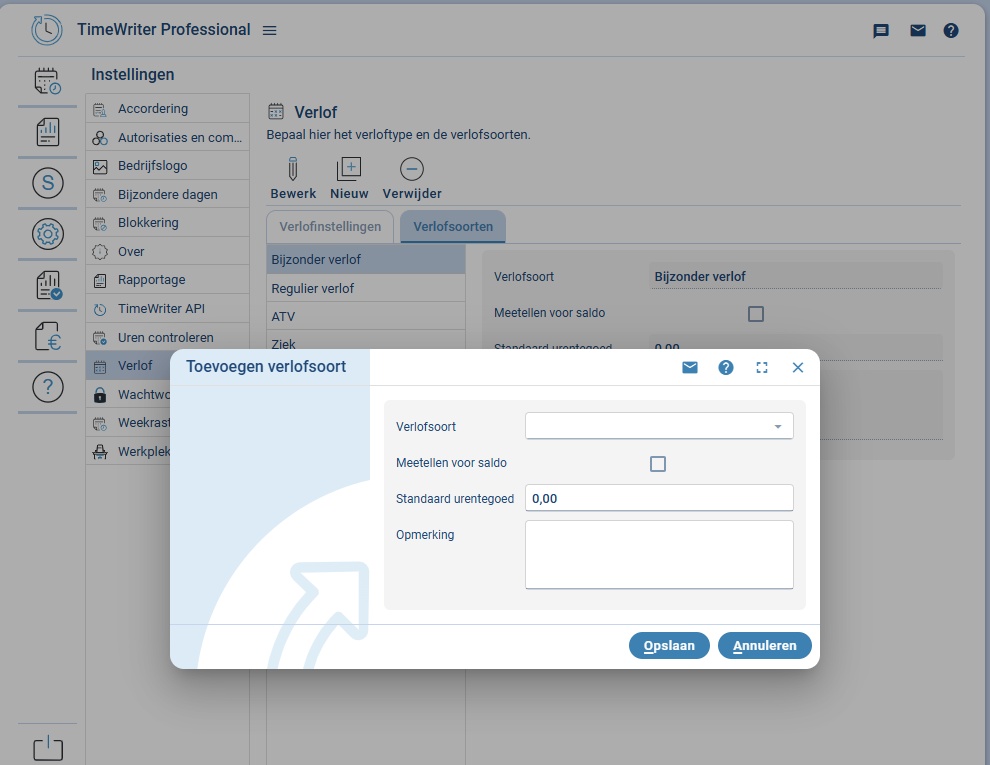
With TimeWriter you bring leave management and time tracking together in one clear system. Employees log their hours worked and request leave, while managers can assess requests and keep insight into staffing levels. The administration has up-to-date data without having to combine different files and systems.
One system. One overview. Less administration.
[Try for free] [Request a demo]
What is the difference between leave management and time tracking?
Time tracking is about the time an employee works. Think of regular working hours, overtime, project hours, hours per client and time spent on specific tasks. Leave management, on the other hand, records when an employee is not working, for example because of holiday, special leave, parental leave, care leave or another form of absence.
In themselves these are different administrative processes, but in practice they constantly influence each other. By bringing both processes together in one system, you get a complete picture of the available and recorded time of every employee. You not only see how much someone has worked, but also when and why someone was unavailable.
Leave management and time tracking aligned with each other
An employee works, takes leave or is absent for another reason. When this data is kept in separate systems, you regularly have to compare information between those systems. With integrated tracking, hours, leave and absence are viewed from the same administration.
Once a leave request has been approved, this information is available in the overview of the employee concerned. This gives a clearer picture of the available time and avoids having to lay different administrations side by side for a complete overview.
For employees
Employees can log their hours worked, request leave and view the status of their requests. They can also gain insight into their leave balance and look up earlier entries. This means employees themselves have access to the information they need most, and not every question about hours or leave has to end up with the administration.
For managers
Managers gain insight into outstanding leave requests, planned absence and the available staffing within the team. Combined with the recorded hours, this gives a broader picture of how employees are deployed. That makes it easier to assess requests and take the available capacity into account.
For the administration
The administration has one central source for hours and leave data. That makes checking hours, leave administration and reporting clearer and reduces the need to merge data from different files or systems.
Request leave without e-mails and loose forms
A leave request does not have to be a cumbersome administrative process. Instead of sending an e-mail to a manager or filling in a form, an employee can record the request directly in the system. The employee chooses the type of leave, indicates the desired period and submits the request. It is then forwarded to the person responsible for assessment.
After approval or rejection, the status of the request remains visible to the employee. This way everyone knows the current situation and the administration does not have to keep track manually of which requests are still outstanding.
Request → assess → approve → process.
Always insight into the current leave balance
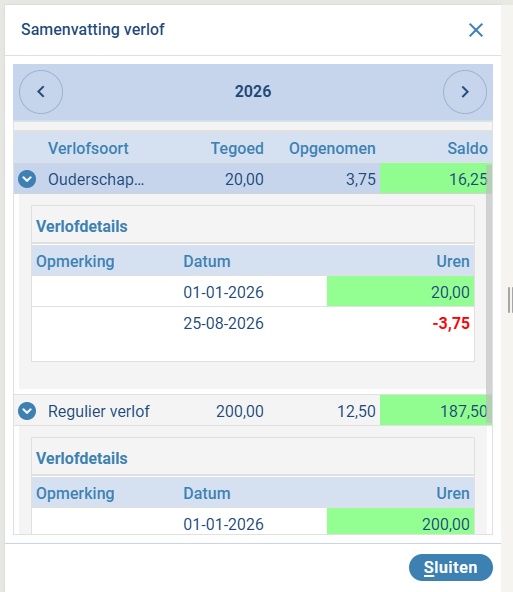
One of the most common questions within an organisation is simple: "How much leave do I have left?" When employees constantly have to contact HR or the administration for this, it creates unnecessary administrative work. With digital leave management, employees can view their available information themselves.
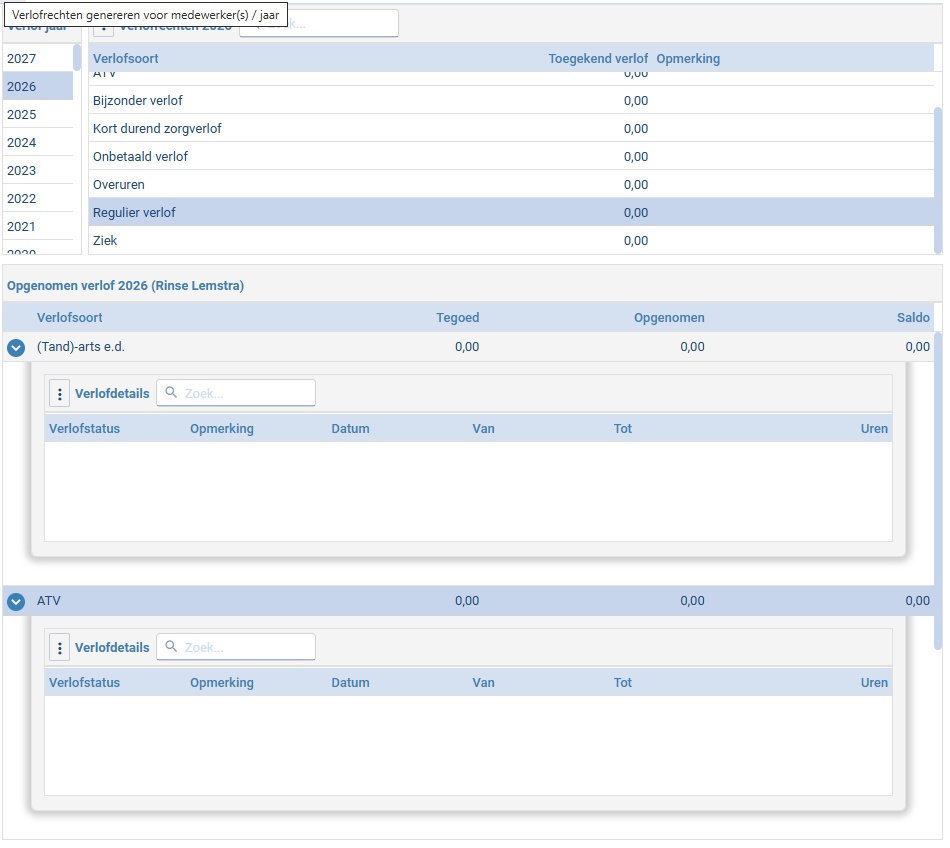
Depending on the configuration, they can for example gain insight into accrued leave, leave taken, planned leave and the remaining leave balance. As a result, employees know better where they stand and the administration receives fewer questions that employees can also answer themselves.
Hours worked and leave in one overview
When time tracking and leave management take place separately, it is difficult to quickly get a complete picture of how time is spent. An employee may, for example, have worked 32 hours, taken 8 hours of holiday and also recorded 2 hours of overtime. When that data is scattered, you have to combine different sources to understand the total.
By combining leave management and time tracking, you get one overview in which different types of time can be viewed side by side. This gives you a fuller picture of how the available time of employees is used.
| Entry |
Example |
| Hours worked |
Regular work |
| Project hours |
Time per project or client |
| Leave hours |
Holiday or other leave |
| Overtime |
Extra time worked |
| Absence |
Other recorded absence |
This creates a central overview of the recorded time and absence of your employees.
Less manual work, less risk of errors
Manual hours and leave administration not only takes time, but also makes it easier to overlook data. A leave request can be left lying, a leave balance can be calculated incorrectly or the same hours can be entered several times. When different Excel files are used, it also quickly becomes unclear which version is the current one.
With digital time tracking and leave management, the data is managed centrally. Requests, entries and changes are available to the users who are authorised for them. As a result, information has to be re-entered less often and it becomes easier to work with up-to-date data.
Take planning and staffing into account
A leave request never stands entirely on its own. When several employees are absent at the same time, this can affect staffing and planning. A manager therefore wants to know not only how much leave someone is requesting, but also what the consequences are for the team.
By recording leave data centrally, you gain insight into planned absence and available employees. Combined with time tracking, you get a better overall picture of your team's deployment. This allows you to assess leave requests better and take timely account of periods in which staffing may come under pressure.
Log hours wherever and whenever it suits
Employees increasingly work in different locations. At the office, at home, on the road or at a client's premises. A time tracking system should therefore not depend on one fixed workplace. TimeWriter offers ways to log hours via different clients and environments, so that employees can record their hours in the way that suits their work.
That is not only practical, but also helps to keep the records up to date. The easier it is for employees to enter their hours, the lower the threshold to update the records straight away rather than having to reconstruct hours from memory afterwards.
From time tracking to reliable administration
The information from your time and leave tracking can be used for various administrative purposes. You gain insight into the time employees spend on clients, projects and tasks, while leave and absence are tracked centrally. The same data can then be used for reports and further administrative processing.
Accounting for hours
Gain insight into the time employees spend on tasks, projects or clients.
Personnel administration
Keep clear track of hours worked, leave and absence from one central administration.
Reports
Create overviews of recorded hours and leave per employee, department, project or period.
Administrative processing
Use recorded data as the basis for further administrative processes and avoid having to gather information again and again.
Which organisations is combined leave and time tracking suitable for?
A combined system for time tracking and leave management is of interest to virtually every organisation with employees. Especially when employees have different tasks, working hours or workplaces, there can be a great advantage in being able to view time worked and absence from one administration.
TimeWriter can be used, for example, in business services, construction and engineering, logistics, healthcare and welfare, manufacturing, installation companies, retail and organisations with many employees working in different locations.
The larger the organisation and the more different teams, working hours and leave types there are, the more important a central and clear administration becomes.
Leave management for small and large teams alike
Small organisations, too, can lose a lot of time on manual leave administration. With five employees an Excel file may still seem manageable, but as an organisation grows, the number of exceptions grows too. Think of different contract hours, part-time employees, several leave types, overtime and different managers.
A digital system can support these processes centrally and grow with the organisation. This prevents leave administration from becoming ever more complex as the number of employees and administrative rules increases.
Why link leave management to time tracking?
Combining both processes mainly pays off because information is no longer scattered across different systems and files. Employees, managers and administration work with the same central data, making the records more transparent and clearer.
One central administration
Hours and leave are managed from one system, without separate files for different parts of the administration.
Up-to-date insight
Employees and managers can have the same up-to-date information about hours, leave and absence.
Less administrative work
Requests, entries and approvals can be handled within one process, so less manual handover is needed.
More transparency
Employees can view their own recorded hours and leave information, depending on the rights and configuration.
Better planning
Planned absence becomes visible, so managers can take it into account when staffing.
Less risk of errors
When information is recorded centrally, the same information has to be copied over manually less often.
Better reports
By bringing information about hours worked, leave and absence together, you get a more complete picture for reporting and analysis.
Frequently asked questions about leave management and time tracking
What is leave management?
Leave management is the administrative recording of leave and other forms of employee absence. It can track which leave has been requested, approved and taken and what leave balance is available.
What is time tracking?
Time tracking is recording the time an employee works. This can relate to regular working hours, projects, clients, activities or specific tasks.
Why combine time tracking and leave management?
Time worked and absence together determine how an employee's available time is used. By managing both processes in one system, you get more overview and information has to be combined manually from different sources less often.
Can employees request leave themselves?
Yes. Employees can submit a leave request themselves. The request can then be put to a manager or other responsible person for assessment and approval.
Can an employee view their leave balance?
Yes. Employees can gain insight into their leave information, such as available, taken and planned leave, depending on the system configuration and the rights granted.
Is leave management also suitable for employees who are often on the road?
Yes. Digital tracking is particularly practical for employees who do not always work at one fixed workplace. Hours can be logged via the available clients and environments, so employees can keep their records up to date on the road or at clients' premises too.
Make time tracking and leave management easier
Stop manually combining timesheets, e-mails and Excel files. Bring time tracking, leave management and absence together in one clear system. Employees log their hours and request leave, managers assess requests and keep an eye on staffing, and the administration has up-to-date data.
This creates one central administration in which time worked and absence come together. Fewer loose files, less duplicate work and more insight for everyone who works with the data.
One system for more overview
Log hours worked.
Manage leave requests.
Keep track of leave balances.
Get a grip on attendance and absence.
[Try TimeWriter for free] [Request a demo]
Discover how TimeWriter can simplify your hours and leave administration.